ATEX Directive
As of April 20, 2016, all products marketed in the European Union intended for use in potentially explosive areas must be approved according to Directive 2014/34/EU, better known as ATEX; this new directive also affects non-electrical components such as pneumatic controls, which must be approved. Here are the key points of Directive 2014/34/EU:
- Devices are assigned to categories which are designated for specific potentially explosive zones.
- Products are identified with the CE mark.
- Instructions for use and declarations of conformity must be provided with each product sold for use in potentially explosive areas.
- Products intended for use in areas potentially explosive due to the presence of dust fall under the directive similarly to products intended for areas with the presence of hazardous gases.
An "explosive atmosphere" is defined as a mixture of air under atmospheric conditions with flammable substances in the form of gases, vapors, mists, or dusts in which, after ignition, combustion spreads throughout the entire unburned mixture (art. 288 of Legislative Decree 81/08). An explosion can occur when the explosive atmosphere comes into contact with an ignition source, which can be:
- of electrical origin (electric arcs, induced currents, heat generated by the Joule effect, electromagnetic waves).
- of mechanical origin (hot surfaces generated by friction, sparks generated by the impact between metallic bodies, electrostatic discharges, ultrasonic adiabatic compressions)
- of chemical origin (exothermic reactions between materials)
- open flames
Products subject to approval are all those that, during normal use or due to malfunction, present one or more ignition sources for potentially explosive atmospheres.
THE UNION OF ELECTRICAL AND MECHANICAL COMPONENTS
According to Directive 2014/34/EU, both electrical and mechanical devices are subject to conformity approval; it is important to note that the component classified in the lowest category defines the class of the entire device of which it is a part. For example, if the coil is marked Ex II 2... and the valve is marked Ex II 3..., the valve + coil assembly cannot be put into service in zone 1 or 21 but only in zone 2 or 22.
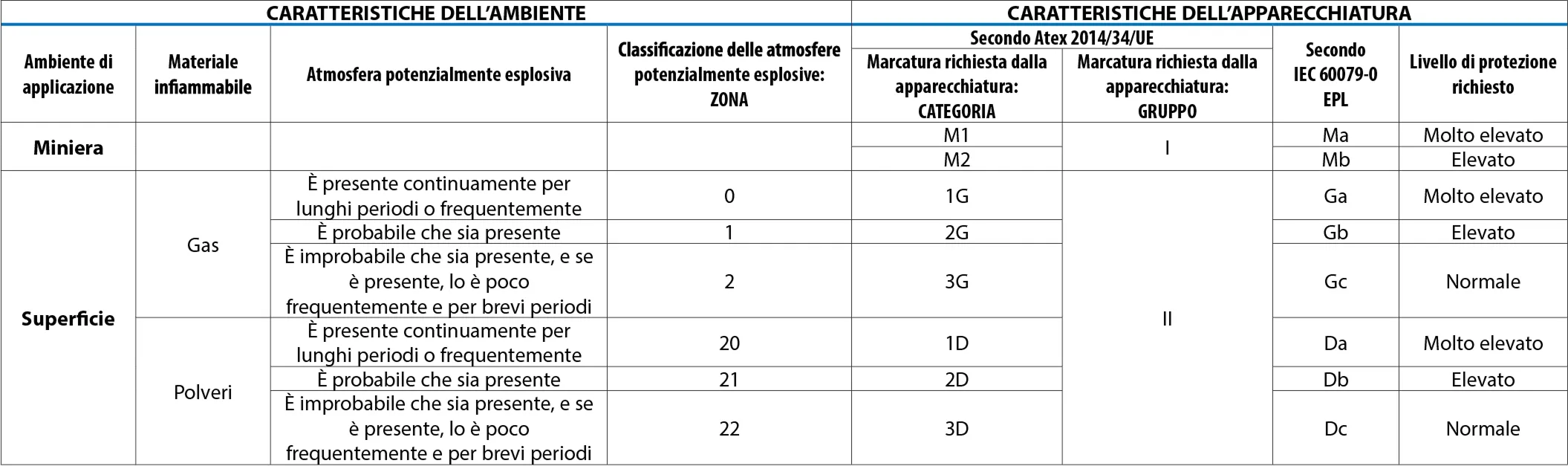
Marking: how to read it


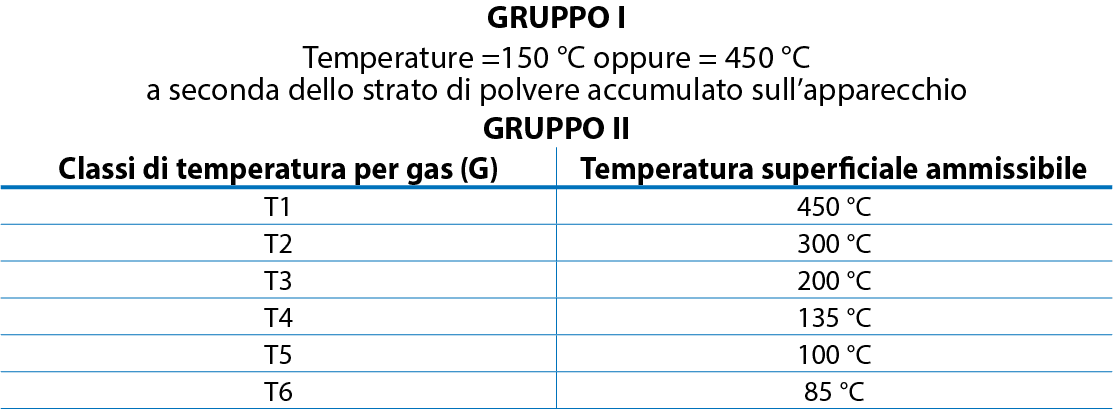
Temperature classes
USER AND SUPPLIER: OBLIGATIONS AND RESPONSIBILITIES
USER: after conducting the risk analysis of their company (based on Directive 99/92/EC) and identifying the risk zone where the purchased components will operate, must communicate it to the SUPPLIER, who must verify that the supplied products are compatible with the indicated zone, that the environmental conditions fall within the operating limits of the components; furthermore, they must ensure that usage instructions are always attached to the various products.